
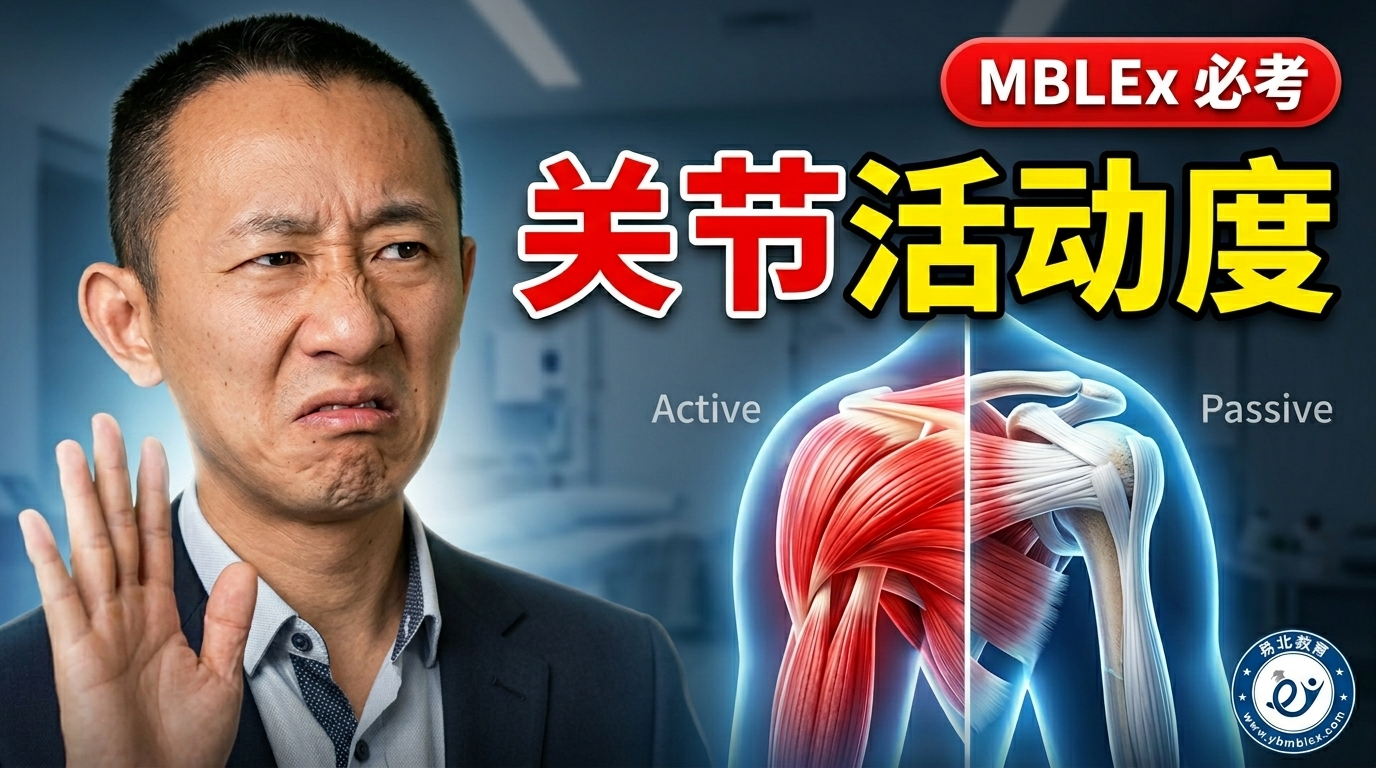
为什么关节活动度是你的考试拦路虎?
你是不是在参加按摩联邦考试时,一看到关节活动度(Range of Motion)相关的评估题就头大?
看着屏幕上的 Active、Passive、Resisted,感觉每一个词都在嘲笑你的记性。你可能觉得是英文不好,或者是年纪大记不住,但真相是:你没掌握评估的底层逻辑。
这17%的权重考点不是靠死记硬背的,而是靠“诊断逻辑”。如果你还没看过我们关于SOAP记录的破案逻辑,建议先读一读,那能帮你建立整体的评估框架。
什么是关节活动度(Range of Motion)?
关节活动度是指一个关节能够移动的最大范围。在按摩联邦考试中,它被分为三种类型,每一种都代表了不同的身体状态。
你可以把关节想象成一扇门。门能不能推开,取决于两个关键:拉门的人(肌肉)有没有力气,以及门的合页(关节和韧带)有没有生锈卡住。这个判断逻辑,是可以被系统训练出来的。而这正是我们十多年在做的事。
核心评估逻辑:谁在用力,谁就负责
要搞定这类题,你只需要盯住一件事:谁在出力?
- 主动活动(Active ROM):你让客人自己动。这时候拉门的人(肌肉)在用力。如果这时候疼,说明肌肉或肌腱出了问题。
- 被动活动(Passive ROM):你帮客人动,客人完全放松。这时候发动机熄火了,全靠钩子(韧带和关节囊)在拉。如果这时候疼,说明是关节或韧带(惰性组织)受伤了。
- 抗阻活动(Resisted ROM):你按住客人,他不准动,但他还得使劲。这时候关节没动,纯粹是肌肉在收缩。这时候疼,直接锁定肌肉损伤。
张老师在视频中用了一个超直观的“开车”比喻来解释关节活动度,强烈建议你看一遍 👇
🎬 张老师视频讲解
文字看不够?视频里有更详细的讲解、记忆口诀和真题演练
⬆️ 点击播放,跟着张老师一起学
真题演练:3步搞定肌肉评估陷阱题
让我们来看一道经典的按摩联邦考试真题:
考试真题:一位客人在进行主动肩外展(Active ROM)时感到疼痛,但在被动活动(Passive ROM)时不疼。哪种结构最可能受伤?
A. Ligament (韧带)
B. Joint capsule (关节囊)
C. Muscle or tendon (肌肉或肌腱)
D. Bursa (滑囊)
解题套路:
1. 主动疼 = 肌肉在使劲。
2. 被动不疼 = 关节和韧带没问题。
3. 结论:只要肌肉使劲就疼,不使劲不疼。选 C。
这套方法适用于所有关于关节活动度的题目。如果你对基础术语还不熟悉,可以参考我们的解剖方位词学习指南。
常见问题 FAQ
Q: 什么是关节活动度(Range of Motion)?
Q: 如何快速记忆主动与被动活动?
Q: 关节活动度在按摩联邦考试中占多少比例?
✅ 本文要点回顾
- 关节活动度是判断组织受损部位的黄金标准。
- 主动疼找肌肉,被动疼找关节。
- 不要死记硬背单词,要记“谁在出力”的逻辑。
- 掌握评估逻辑是通往合法执照的必经之路。

张维麟(Weilin Chang)
易北教育创始人,按摩联邦考试辅导专家。已帮助超过六百三十位华人通过了按摩联邦考试。专注于用中文教学帮助英文零基础、年纪大的在美华人突破语言障碍,轻松备考。
Understanding Range of Motion (ROM) for MBLEx: A Comprehensive Guide
Range of Motion (ROM), or 关节活动度, is a foundational concept in orthopedic assessment and kinesiology. For candidates preparing for the Massage & Bodywork Licensing Examination (MBLEx), understanding the nuances between different types of ROM is crucial. This knowledge represents a significant portion of the assessment category, which accounts for 17% of the total exam weighting.
At YiBei Education (易北教育), we emphasize a logical approach rather than rote memorization. Understanding the physiological differences between contractile and inert tissues is the key to mastering ROM questions. Contractile tissues include muscles, tendons, and their attachments. Inert tissues consist of ligaments, joint capsules, bursae, and nerves.
Active Range of Motion (AROM) occurs when the client performs a movement using their own muscle power. This test evaluates the client’s willingness to move, muscle strength, and coordination. If a client experiences pain during AROM, it suggests a lesion in the contractile tissue because the muscle is contracting and shortening. However, it could also involve inert tissue if those structures are being compressed or stretched during the movement.
Passive Range of Motion (PROM) is performed by the therapist while the client remains completely relaxed. Since the client’s muscles are not contracting, PROM primarily stresses inert tissues like ligaments and the joint capsule. If pain is present during PROM but absent during AROM, the therapist can reasonably conclude that the injury lies within the inert tissue rather than the muscle.
Resisted Range of Motion (RROM), often referred to as manual muscle testing, involves the therapist providing resistance while the client attempts to hold a joint in a neutral position. Because the joint does not move, the inert tissues are not stretched. Therefore, pain during RROM is a strong indicator of a strain in the muscle or tendon. This process of elimination is known as Cyriax’s method of selective tissue tension.
In clinical practice and on the exam, you may encounter scenarios where both AROM and PROM are restricted or painful. This often indicates a “capsular pattern,” suggesting inflammation or fibrosis of the entire joint capsule. Understanding these clinical patterns helps you differentiate between a simple muscle strain and a more complex joint condition.
When studying 关节活动度 (Range of Motion), focus on the ‘end-feel.’ The end-feel is the quality of resistance felt by the therapist at the end of the PROM. Normal end-feels include soft (tissue approximation), firm (stretching of ligaments), and hard (bone contacting bone). Abnormal end-feels, such as ’empty’ (stopped by pain) or ‘springy block’ (internal derangement), are high-yield topics for the MBLEx.
We help Chinese-speaking students bridge the gap between their hands-on experience and the academic requirements of the Massage & Bodywork Licensing Examination. By translating complex physiological concepts into relatable analogies, we ensure our students feel confident in the testing center. Remember, the exam is not just a test of English; it is a test of your professional clinical judgment.
Proper documentation of ROM findings is also essential. Results should be recorded in the Objective (O) section of the SOAP note. For instance, recording ‘Decreased AROM in shoulder abduction due to pain’ provides clear data for treatment planning. Mastery of 关节活动度 assessment allows you to provide safer, more effective treatments and protects you from potential liability in your professional career.
In summary, ROM is your diagnostic tool. Use AROM to test the engine (muscle), PROM to test the frame (ligaments/joint), and RROM to isolate the engine without moving the frame. This logical framework will turn difficult assessment questions into easy points on your journey to becoming a licensed massage therapist.
备考路线图:如果你才刚开始准备,建议先从 按摩联邦考试(MBLEx)完全指南 看起,把考试范围、报名流程和备考顺序一次弄清楚,再回来啃单个考点。