
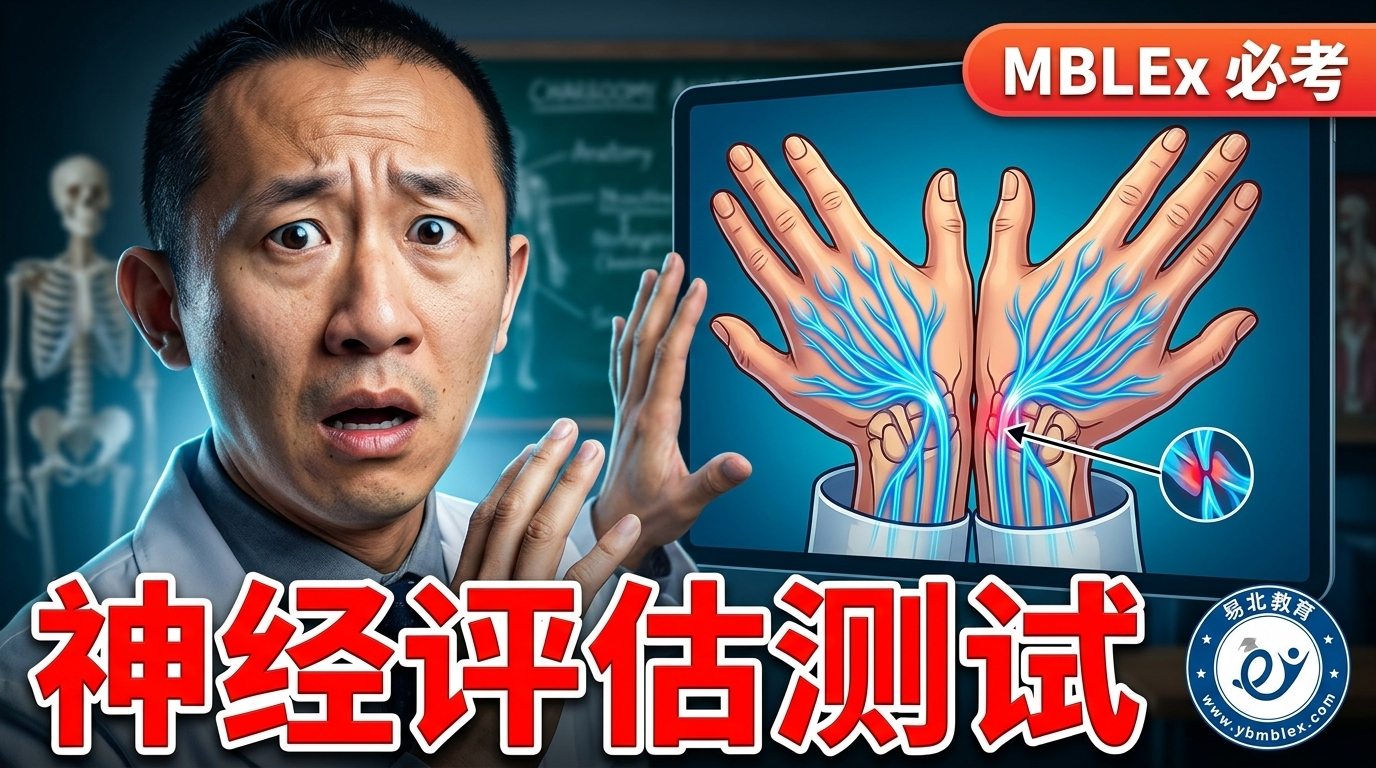
为什么费伦实验与提内耳征是拿分关键?
你在备考时,是不是觉得费伦实验与提内耳征这两个词特别拗口?考不过,就要等三十天才能重考,还要再交两百六十多美金。其实,这不只是考试问题,更是职业尊严的问题。在按摩联邦考试中,临床评估占了17%的权重,而正中神经(Median Nerve)的检查又是重中之重。
你盯着屏幕手心冒汗,看到临床术语就脑子发虚,这说明你还没有建立动作逻辑。你以为是因为英文差,其实是因为你还在死记硬背。如果你不能在考场上分辨出这些测试,你就很难进入正规诊所,拿到那张让你在美国能真正抬起头的执照。今天,张老师就教你一套“电线检查法”,帮你秒杀费伦实验与提内耳征相关的题目。
电线检查法:3秒看穿临床评估陷阱
这两个测试本质上是在检查人体内的“电线”——也就是神经是否受了委屈。掌握这个黄金公式:施加压力的方式 + 持续时间 = 诊断信号。你只需要看是“长时间折叠”还是“快速敲击”。
1. 什么是费伦实验 (Phalen’s Test)?
费伦实验与提内耳征中的第一个重点是折叠逻辑。想象一下,费伦实验 (Phalen’s Test) 就像是折叠一根电线。动作是手背靠手背下压,持续六十秒。如果电线被压瘪了,手就开始发麻,这说明正中神经在腕管处受压了。记住:折叠是为了制造挤压空间。
2. 什么是提内耳征 (Tinel’s Sign)?
而提内耳征 (Tinel’s Sign) 则是快速敲击电线。你需要用手指轻轻弹拨手腕正中神经的位置。如果电线漏电了,客人会有触电的感觉。记住:敲击是为了引起神经放电。如果你对解剖位置还不熟悉,建议先阅读我们关于解剖方位词的文章,建立立体空间感。
考试重点:费伦实验看的是持续挤压(Compression),提内耳征看的是机械敏感度(Percussion)。
🎬 张老师视频讲解
文字看不够?视频里有更详细的讲解、记忆口诀和真题演练
⬆️ 点击播放,跟着张老师一起学
真题演练:考官是如何利用习惯误导你的?
很多人看到“手麻”两个字就立刻想选费伦实验,这是考官最阴险的陷阱。来看这道模拟题:
客人报告大拇指和食指发麻。按摩师在手腕处轻敲正中神经。请问这是在进行哪项评估?
A. 费伦实验 (Phalen’s Test)
B. 提内耳征 (Tinel’s Sign)
C. 艾伦测试 (Allen’s Test)
D. 汤普森测试 (Thompson Test)
答案是B。因为题目里出现了“轻敲(Tap/Tapping)”这个动作。如果你选了A,说明你还在靠背单词猜答案。这种判断逻辑是可以被系统训练出来的,而这正是我们易北教育十多年在做的事。通过建立这种动作逻辑,即使你英文零基础,也能在按摩联邦考试中看穿费伦实验与提内耳征的区别。就像我们之前讲过的关节活动度判断一样,逻辑才是过关的关键。
常见问题 FAQ
Q: 费伦实验与提内耳征分别检查什么?
Q: 在按摩联邦考试中,评估题比例大吗?
✅ 本文要点回顾
- 费伦实验 (Phalen’s Test) = 折叠、持续压力、手背靠手背。
- 提内耳征 (Tinel’s Sign) = 敲击、弹拨、漏电感。
- 两者都是检查正中神经(Median Nerve)在手腕处的卡压。
- 理解动作逻辑比死记硬背英文单词更重要。

张维麟(Weilin Chang)
易北教育创始人,按摩联邦考试辅导专家。已帮助超过六百三十位华人通过了按摩联邦考试。专注于用中文教学帮助英文零基础、年纪大的在美华人突破语言障碍,轻松备考。易北教育,通过考试更简易!
Understanding Phalen’s Test and Tinel’s Sign for MBLEx: A Comprehensive Guide
For candidates preparing for the Massage & Bodywork Licensing Examination, clinical assessment remains a high-stakes domain. Specifically, differentiating between 费伦实验与提内耳征 (Phalen’s Test and Tinel’s Sign) is essential for identifying Carpal Tunnel Syndrome (CTS). This condition occurs when the median nerve is compressed as it passes through the wrist.
Phalen’s Test is a provocative clinical maneuver. It requires the client to place the dorsal surfaces of their hands together with wrists in maximal flexion for at least 60 seconds. This action reduces the volume of the carpal tunnel, increasing pressure on the median nerve. A positive result is indicated by tingling or numbness in the thumb, index, and middle fingers. In Chinese study circles, this is often linked to the core concept of 费伦实验与提内耳征.
Tinel’s Sign, conversely, involves percussion. The therapist taps over the carpal tunnel where the median nerve is most superficial. If the client experiences a shooting, electric-shock sensation radiating into the hand, the sign is positive. This indicates hypersensitivity of an injured or regenerating nerve. At YiBei Education (易北教育), we emphasize that “Tinel’s involves Tapping.”
The MBLEx often tests these through scenario-based questions. A typical question might describe a therapist applying pressure or percussing the wrist. Students must identify the specific test based on the action performed, not just the symptom of numbness. Understanding the mechanics of the median nerve pathway is vital for both the exam and clinical safety.
Beyond the exam, these tests are critical for professional scope of practice. As a licensed massage therapist, recognizing when to refer a client to a physician is a core competency. The 17% weight allocated to assessment in the MBLEx reflects the importance of client safety and clinical reasoning.
Many Chinese-speaking students struggle with these terms due to the language barrier. However, by focusing on the physical action—compression versus percussion—students can bypass linguistic hurdles. YiBei Education has helped over 630 students achieve their licenses by translating these complex medical concepts into intuitive logical frameworks.
When studying for the MBLEx, remember that the Median Nerve supplies the palmar side of the thumb and first two and a half fingers. If a question mentions numbness in the pinky, you should immediately rule out carpal tunnel-related tests like 费伦实验与提内耳征, as the pinky is supplied by the ulnar nerve.
Carpal Tunnel Syndrome is a common occupational hazard for massage therapists themselves. Learning these tests helps you monitor your own health as well. Maintaining proper body mechanics and wrist alignment during deep tissue work is essential to prevent nerve entrapment.
The distinction between these two tests lies in the stimulus. Phalen’s uses static, prolonged flexion, while Tinel’s uses dynamic, brief percussion. If the exam mentions a stopwatch or a duration of 60 seconds, look for Phalen’s in the options. If it mentions a light tap or reflex hammer, look for Tinel’s.
By mastering 费伦实验与提内耳征, you secure valuable points in the Client Assessment section. More importantly, you demonstrate the clinical expertise required to provide high-quality care in the US healthcare landscape. Your license is the key to professional freedom and high-income opportunities.
备考路线图:如果你才刚开始准备,建议先从 按摩联邦考试(MBLEx)完全指南 看起,把考试范围、报名流程和备考顺序一次弄清楚,再回来啃单个考点。