
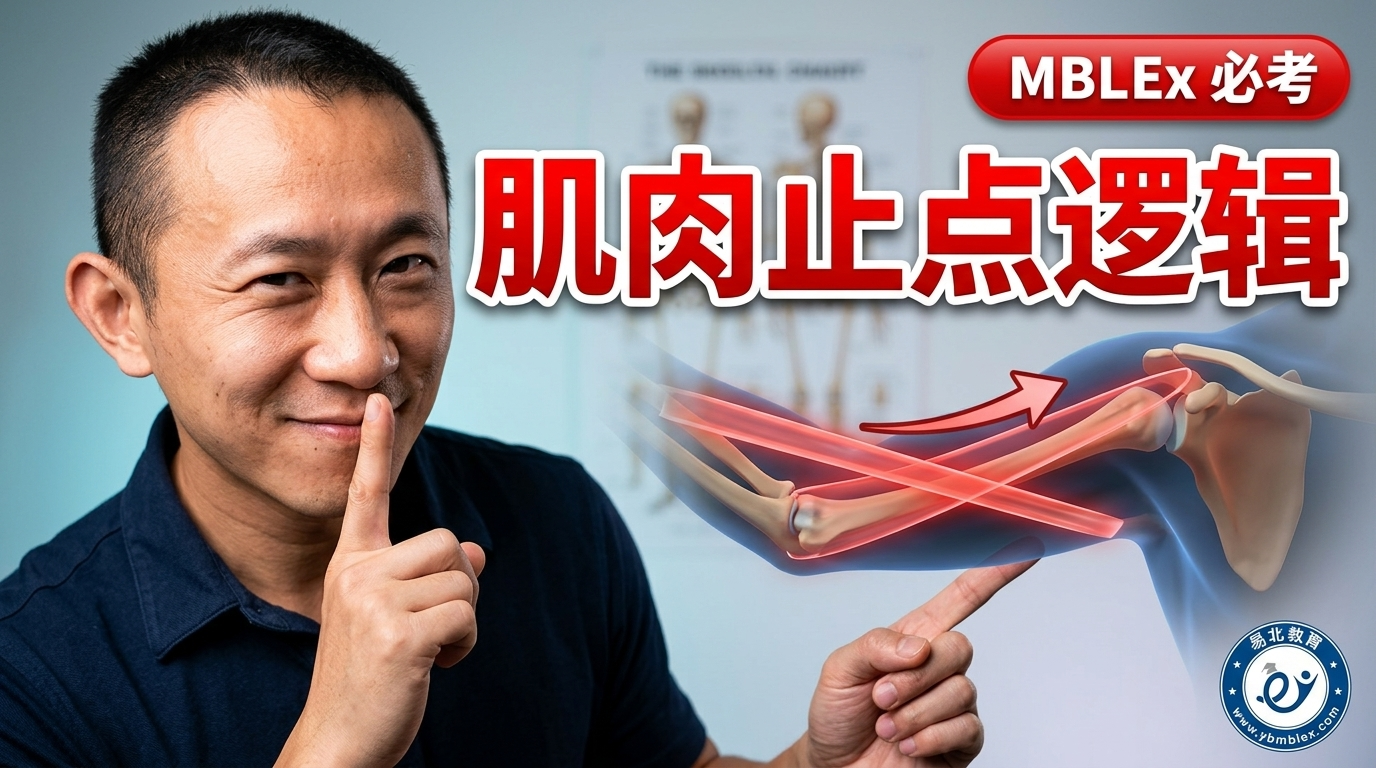
什么是肌肉起止点(Origin & Insertion)?
在按摩联邦考试中,运动学(Kinesiology)占据了相当大的比例。很多同学觉得难,是因为他们试图去硬背几百块肌肉的肌肉起止点。但你要明白,肌肉其实就是一根“橡皮筋”。这根橡皮筋连接着两块骨头。当肌肉收缩时,它会变短,从而拉动骨头产生动作。所谓Origin(起点),就是相对稳定、不怎么动的一端;而Insertion(止点),就是被拉动、产生位移的一端。如果你还没看过我们关于医学英语词根的详解,建议先读一读,那能帮你更快认出肌肉名字。考试重点:在标准的按摩联邦考试题目中,如果没有特殊说明,默认动作是“止点(Insertion)向起点(Origin)移动”。

3个核心公式:把解剖学变成逻辑推导
与其死记硬背,不如掌握这三个生活化的公式。只要公式对,答案自然就出来了:- 公式一:Origin = 树根。 深扎在地里,考试中它是那个“不动”的支点。
- 公式二:Insertion = 树枝。 你拉动树枝,树枝只会往树根的方向靠拢。
- 公式三:动作性质 = 缩短的方向。 看肌肉纤维是怎么长的,它缩短时,骨头往哪走,那个动作(Action)就是答案。
🎬 张老师视频讲解:3个公式秒杀OIA
文字看不够?视频里有更详细的讲解、记忆口诀和真题演练
⬆️ 点击播放,跟着张老师一起学
真题拆解:胸大肌如何决定肱骨动作?
让我们来看一道典型的按摩联邦考试真题:当胸大肌(Pectoralis Major)收缩时,肱骨(Humerus)会发生什么动作?很多人一看到 Pectoralis Major 就慌了。冷静一下,用我们的公式:胸大肌长在胸口和锁骨上,这是相对不动的起点(Origin);它的另一头连在肱骨(大臂骨)上,这是被拉动的止点(Insertion)。肌肉一收缩,大臂是不是往身体中间靠?往中线靠,就是 Adduction(内收)。看,你根本不需要背单词,只要脑子里有这幅画,答案 B 就在那里。这类逻辑在场景题破解技巧中也同样适用。考官最爱设的3个陷阱选项
在涉及肌肉起止点的题目中,考官最喜欢利用“相反动作”来迷惑你。比如:- 大腿前侧 (Quads)
- 背部 (Latissimus)
- 胸部 (Pectoralis)
| 肌肉位置 | 正确动作 (Action) | 陷阱选项 (Trap) |
|---|
常见问题 FAQ
Q: 什么是肌肉起止点(OIA)?
A: OIA 代表起点 (Origin)、止点 (Insertion) 和动作 (Action)。起点通常是靠近身体中心且固定的骨骼连接点,止点是远离中心且在收缩时移动的连接点。
Q: 动作分析题在考试中占比多大?
A: 运动学(Kinesiology)通常占按摩联邦考试总分的 12% 左右,但它与临床评估和按摩技巧高度关联。
Q: 英文不好,背不下来肌肉名字怎么办?
A: 不要死背全称。学习词根(如 Brachii 指手臂,Femoris 指大腿),结合位置理解逻辑。易北教育的课程专门为零基础华人设计了这种逻辑记忆法。
✅ 本文要点回顾
- 起点 (Origin) 是不动端,止点 (Insertion) 是移动端。
- 理解肌肉收缩的“拉力”方向,而非死记单词。
- 遇到题目先确定谁在动(止点),再看它往哪靠。
- 利用“树根与树枝”的画面感进行快速联想。

张维麟(Weilin Chang)
易北教育创始人,按摩联邦考试辅导专家。已帮助超过 634 位华人学员成功通过考试。专注于用中文教学帮助在美华人突破语言障碍,轻松拿证。
Understanding Muscle Origin, Insertion, and Action (OIA) for MBLEx
Mastering the concepts of 肌肉起止点 (Muscle Origin and Insertion) is fundamental for success on the MBLEx. In kinesiology, the “Origin” is defined as the attachment site that doesn’t move during contraction, while the “Insertion” is the attachment site that does move. At YiBei Education (易北教育), we emphasize that understanding the mechanical pull is more important than memorizing vocabulary lists.When a muscle contracts, it generates tension between its two attachment points. This tension results in the 肌肉起止点 (Muscle Origin and Insertion) drawing closer together. By convention, we say the insertion moves toward the origin. For instance, consider the Biceps Brachii. Its origin is on the scapula, and its insertion is on the radius of the forearm. When it contracts, the radius is pulled toward the scapula, resulting in elbow flexion.To excel in the kinesiology section, students must understand types of muscle contractions. Isotonic contractions involve a change in muscle length, further divided into concentric (shortening) and eccentric (lengthening). Isometric contractions involve no change in length but generate tension, such as holding a plank position. These concepts often overlap with 肌肉起止点 questions in scenario-based exam formats.Functional kinesiology also considers the role of agonists and antagonists. The agonist, or prime mover, is the muscle primarily responsible for a movement. The antagonist opposes that movement. For example, during elbow flexion, the Biceps Brachii is the agonist while the Triceps Brachii is the antagonist. Knowing the 肌肉起止点 helps you identify which muscle is performing which role.Many students struggle with anatomical terminology. Terms like “proximal” and “distal” are often used to describe the location of 肌肉起止点. Generally, the origin is more proximal (closer to the trunk), and the insertion is more distal (further from the trunk). Learning these spatial relationships helps you visualize the muscle’s function without needing to translate every word.At YiBei Education (易北教育), we provide comprehensive charts for all major muscles covered in the MBLEx. This includes the Pectoralis Major, Latissimus Dorsi, Deltoid, and the Rotator Cuff group. By focusing on the 肌肉起止点 logic, students can deduce the action of muscles they may not have studied in depth. This deductive reasoning is the “secret sauce” that helps our students achieve high pass rates.Another critical area is the planes of motion. Movements like abduction and adduction occur in the frontal plane, while flexion and extension occur in the sagittal plane. Rotation occurs in the transverse plane. Understanding how the 肌肉起止点 alignment dictates the plane of motion is essential for answering advanced movement analysis questions correctly.Clinical application is the ultimate goal. For a massage therapist, knowing the 肌肉起止点 allows for precise palpation and effective treatment planning. If a client presents with restricted range of motion, identifying the hypertonic muscle based on its OIA allows for targeted release. This professional competence starts with mastering the MBLEx theory.Finally, remember that the MBLEx is a computer-adaptive test. If you consistently miss questions regarding 肌肉起止点, the system will provide more of them to assess your weakness. Building a solid foundation in kinesiology logic prevents the test from becoming increasingly difficult. Our mission at YiBei Education (易北教育) is to ensure you enter the testing center with absolute confidence.In summary, don’t just memorize; visualize. See the muscle as a bridge between bones. Identify the anchor (Origin) and the lever (Insertion). Once you see the direction of the pull, the correct answer for the Action will be obvious. This is the logic that has helped 637+ students transform their lives. YiBei Education, making the exam easier for you! 易北教育,通过考试更简易!📝 完整视频文字稿
以下是本期视频的完整文字内容,方便您随时复习参考。
▶ 点击展开完整文字稿
你盯着屏幕上的 Insertion(止点)。脑袋一片空白。这是你第几次卡在这种题上了?明明背过,一换题就不会。背了忘,忘了背。你觉得是年纪大?还是英文不好?都不是。是你根本没看懂肌肉在”做什么”。这类题一旦选错,你丢掉的不只是分数。是你通过考试、合法工作的机会。今天,我给你一套逻辑。让你不用死记硬背,也能选对。其实肌肉很简单。就是一根”橡皮筋”。它连接两块骨头。一块相对稳定,一块被它拉动。你只需要看懂:谁在拉谁。搞懂这一点,动作分析题,会突然变简单。你只需要记住三件事:第一件:Origin(起点)= 相对稳定的一端。就像地基,不轻易动。第二件:Insertion(止点)= 相对移动的一端。就像门把手,被拉着走。第三件:在考试中,我们默认止点向起点移动。记住一句话:谁动,谁就是答案。来看一道按摩联邦考试常见题:When the Pectoralis Major contracts, what movement occurs at the humerus?
当胸大肌(Pectoralis Major)收缩时,肱骨(Humerus)会发生什么动作?A. Extension(伸展)
B. Adduction(内收)
C. Lateral rotation(外旋)
D. Abduction(外展)不要翻译单词。只看逻辑:胸口这一侧,在考试里通常当作稳定端(Origin)。大臂的肱骨,是被拉动的一端(Insertion)。肌肉一收缩,大臂是不是往身体中间靠?往中线靠,就是内收(Adduction)。正确答案是 B。很多人会选 D,甚至选 C。因为他们分不清:是”拉回来”,还是”推出去”。考官最喜欢用这种方向相反的词来设陷阱。很多人学了三个月,遇到这类题还是只能猜。如果你在考场上靠猜,你就是在拿执照开玩笑。更重要的是——在实际操作中,如果你连肌肉拉动方向都搞错,可能会让受伤的客人更严重。这个判断逻辑,是可以被系统训练出来的。而这正是我们十多年在做的事。为了让你一辈子不忘,记住这两个画面:Origin(起点)= 树根。深扎在地里,不动。
Insertion(止点)= 树枝。你拉树枝,树枝只会往树根方向弯。做题顺序:先找树根(Origin),再看树枝往哪走(Insertion)。答案自然出来。你一直过不了考试,不是因为你不努力。是因为方法不对。我是易北教育张老师。这十多年,我们一直在做一件事:把复杂的解剖知识,变成你能理解、能应用的逻辑。帮助了超过六百三十位英文零基础、年纪大的华人,通过了按摩联邦考试,拿到了他们的执照。他们中很多人,连 ABC 都认不全。但他们通过了。不是因为他们更聪明。是因为他们终于用对了方法。这张执照,不只是一张纸。是你在美国合法赚钱的资格。是你可以安心工作、养家糊口的底气。你是不是还在靠猜题?是不是背了单词还是不会做题?是不是学了后面忘前面?这不是你的问题。是方法的问题。不知道自己卡在哪类题?评论区打:OIA,我教你用这套逻辑,把动作题一类一类打通。或者直接私信我,我帮你看你卡在哪一步。易北教育,通过考试更简易!
延伸阅读:想知道这一题在整张卷子里占什么位置,可以对照 7 大板块的官方占比——完整说明在 按摩联邦考试(MBLEx)完全指南。