
糖尿病禁忌:为什么死记硬背会让你丢分?
你在参加按摩联邦考试时,是不是最怕看到一串长长的病理词汇?Diabetes Mellitus(糖尿病)、Neuropathy(神经病变)、Hypertension(高血压)。这些词像砖头一样,砸在很多英文基础薄弱的华人考生心里。你可能觉得,如果不把这些医学大部头背完,你就过不了关。
但在糖尿病禁忌这类题目上,死记硬背往往是失败的开始。考官只要换个说法,你就会陷入纠结。丢掉病理学这13%的分数,意味着你可能要多等30天,再交265美金重考。这种焦虑,每一个在法拉盛、丁胖子广场奋斗的按摩师都懂。其实,你缺的不是单词量,而是判断逻辑。如果你还没看过我们关于按摩联邦考试自适应系统的得分逻辑,建议先读一读,理解考试是如何出题的。
第一招|什么是“管道安全评估”逻辑?
为了帮你掌握糖尿病禁忌,我发明了一套“管道逻辑”。想象你住的旧公寓,里面的供水管网老化了。糖尿病和心血管病,就是这套管网出了问题。有的管子脆了,有的管子堵了。
考试重点:疾病的控制状态 + 潜在的组织风险 = 你的操作调整。你需要判断管子是脆的、还是堵的,或是哪里有补丁。
这个判断逻辑,是可以被系统训练出来的。而这正是我们十多年在做的事。通过这种生活化的类比,即使英文零基础、年纪大的华人考生也能快速找准考点。
第二招|糖尿病禁忌如何区分:什么时候是局部,什么时候是全身?
这是按摩联邦考试中最常见的陷阱。很多考生一看到糖尿病就选“全身禁忌”。其实,核心在于糖尿病禁忌的细分判断:
- 管子发脆(神经病变 Neuropathy):客人的感觉不灵敏。这不是绝对禁忌,而是力度调整。你要避开深度按压,防止他在没感觉的情况下受伤。
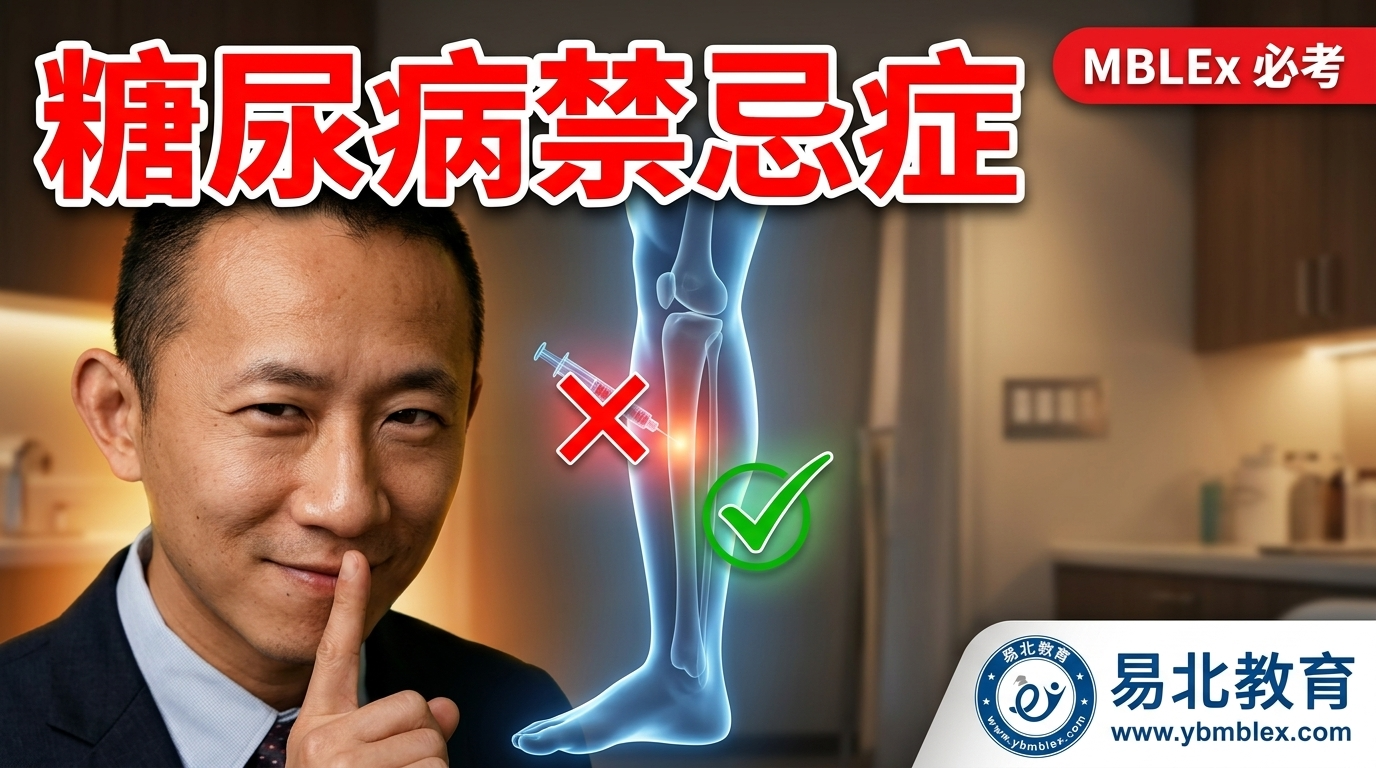
- 注射位点(Insulin Injection Site):这是一个明确的局部禁忌。按摩会加速血液循环,导致药物被身体过快吸收,引发低血糖。
张老师在视频中用了一个超直观的比喻来解释这个概念,强烈建议看一遍 👇
🎬 张老师视频讲解:病理学必拿分逻辑
文字看不够?视频里有更详细的讲解、记忆口诀和真题演练
⬆️ 点击播放,跟着张老师一起学
第三招|心血管疾病:哪些情况属于绝对禁忌?
如果说糖尿病通常是调整力度或避开局部,那么心血管疾病往往涉及生命安全。在按摩联邦考试中,区分绝对禁忌是职业素养的底线。
想象下水道里有一块大石头(深静脉血栓 DVT)。如果你用高压水枪(强力按摩)去冲,石头飞到肺部,后果不堪设想。这种管子“死死堵住”的情况,就是绝对禁忌。我们要学会根据 FSMTB 的大纲要求,守住安全边界。分不清这些细节,不是因为你英文不好,是因为没有人帮你理顺安全逻辑。
真题模拟与陷阱分析
让我们来看一道典型的糖尿病禁忌相关真题:
Question: Which of the following is a local contraindication for a client with type 2 diabetes?
- A. Peripheral neuropathy
- B. Controlled hypertension
- C. An insulin injection site
- D. History of heart attack
答案解析:正确答案是 C。题目问的是“局部禁忌”。神经病变(A)需要调整力度,而不是完全不碰;受控的高血压(B)和心脏病史(D)是全身性的考虑。只有注射部位是不能碰的“坏掉的接头”。这种三选一或四选一的技巧,我们在三选一题型解析中有更深入的拆解。
常见问题 FAQ
Q: 糖尿病患者可以接受按摩吗?
Q: 什么是按摩中的局部禁忌症?
Q: 病理学在按摩联邦考试中占多少比例?
✅ 本文要点回顾
- 掌握“管道逻辑”:分清管子是脆的(调整)还是堵的(停止)。
- 明确糖尿病禁忌:注射部位是局部禁止,神经病变是调整力度。
- 心血管风险:DVT 等血栓情况属于绝对禁忌,严禁操作。
- 系统测评:不要盲目背题,先找准自己的逻辑短板。

张维麟(Weilin Chang)
易北教育创始人,按摩联邦考试辅导专家。已帮助超过六百三十位华人通过了按摩联邦考试。专注于用中文教学帮助英文零基础、年纪大的在美华人突破语言障碍,轻松备考。
Understanding Diabetes and Cardiovascular Contraindications for MBLEx: A Comprehensive Guide
Pathology is a critical pillar of the Massage & Bodywork Licensing Examination, commonly known as the MBLEx. It accounts for approximately 13% of the total questions. For many candidates, especially those from non-English speaking backgrounds, topics like 糖尿病禁忌 (Diabetes Contraindications) and cardiovascular disorders pose a significant challenge due to complex medical terminology. However, mastering these concepts is not just about passing the exam; it is about ensuring client safety in a professional clinical setting.
Diabetes Mellitus is a metabolic disorder characterized by high blood glucose levels. In the context of massage therapy, we must differentiate between various complications. One of the primary concerns is peripheral neuropathy. Neuropathy leads to a loss of sensation, particularly in the extremities. For a therapist, this means the client cannot provide accurate feedback regarding pressure. This is not a total contraindication but a reason for caution. You must avoid deep tissue work to prevent tissue damage that the client may not feel. In Chinese, we often explain this through the concept of 糖尿病禁忌 to help students visualize the risks.
Another vital exam point is the insulin injection site. For clients who manage their condition with insulin, the site of injection is a strict local contraindication. Massage increases local circulation, which can cause the insulin to be absorbed into the bloodstream far more rapidly than intended. This rapid absorption can lead to a sudden drop in blood sugar, known as hypoglycemia, which is a medical emergency. At YiBei Education (易北教育), we emphasize that 糖尿病禁忌 must be handled with professional precision to avoid such risks.
Cardiovascular conditions also fall under the pathology umbrella. Hypertension, or high blood pressure, is very common. If it is controlled through medication or lifestyle, massage is generally beneficial as it promotes relaxation. However, uncontrolled hypertension requires a physician’s clearance. The most critical cardiovascular contraindication is Deep Vein Thrombosis (DVT). DVT involves a blood clot, usually in the lower leg. Performing massage on a client with DVT is a total contraindication because the pressure could dislodge the clot, leading to a pulmonary embolism.
The FSMTB (Federation of State Massage Therapy Boards) expects candidates to distinguish between absolute contraindications and local contraindications. An absolute contraindication means massage should not be performed at all. A local contraindication means you must avoid a specific area but can work on the rest of the body. Understanding these nuances is the key to scoring high in the pathology section. Many students at YiBei Education (易北教育) find that by using logical frameworks like the “Pipe Safety Assessment,” they can deduce the correct answer even if they don’t know every English word in the question.
When studying for the MBLEx, remember that the exam tests your ability to think like a professional healthcare provider. Whether it’s 糖尿病禁忌 or inflammatory conditions, the goal is to protect the public. Safe practice is the foundation of your license. We encourage all students to move beyond rote memorization. By understanding the underlying physiological mechanisms—how massage affects blood flow and how various diseases alter tissue integrity—you become a better therapist.
At YiBei Education (易北教育), we have helped over 630 students achieve their dreams. Many of our students are older adults with limited English proficiency. We prove every day that with the right method, the MBLEx is not an insurmountable wall. It is simply a gate that requires the right key. By focusing on high-yield topics like 糖尿病禁忌 and systemic pathologies, we provide our students with the most efficient path to success.
If you are struggling with medical terms, don’t lose heart. Focus on the big picture. Ask yourself: Is this condition systemic or local? Is the risk related to sensation or circulation? These are the questions that will lead you to the right answer. For more professional guidance and specific exam strategies, visit ybmblex.com and join our community of successful professionals.
先看懂整场考试:这个考点属于 MBLEx 的考试范围。如果你还不确定按摩联邦考试到底考什么、怎么计分、报名要多少钱,建议先读这篇 按摩联邦考试(MBLEx)完全指南。