
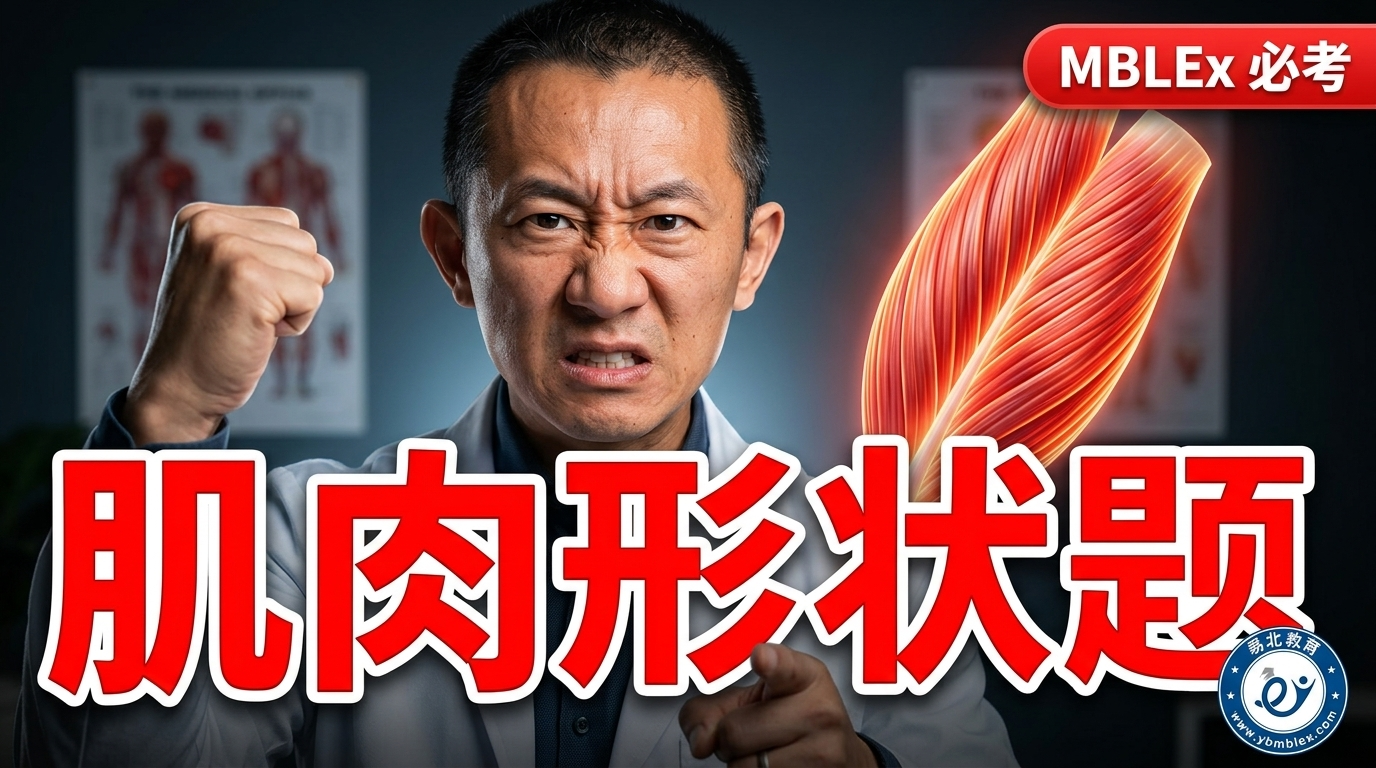
课程片段:一条规则,推出所有肌肉形状(张老师讲解视频)
这段是易北 MBLEx 中文课程「运动学 2.1」里的一段,四分钟。它把这篇文章讲的几种形状,收成一条可以自己推出来的规则。
先认两个词。 line of pull 拉力线,是肌肉的长轴方向,也就是它发力的方向。angle of pull 拉力角,是拉力线和骨头长轴之间的夹角。
规则只有两句话:
- 第一句:一根肌纤维能缩短的比例大体是固定的。所以纤维越长,一次收缩走的距离越大,关节的幅度越大、速度越快。
- 第二句:力气取决于并排干活的纤维根数。同样一块肌肉的体积,把纤维做短、斜着塞进去,就能塞进多得多的根数,力气自然大。
两句放在一起,取舍就出来了:体积就那么多,要么花在长纤维上换幅度和速度,要么花在多根短纤维上换力气,不能两头都要。
考试常问的三件事:
- 会聚肌 convergent 的例子是哪块? 胸大肌 pectoralis major。它的起点铺满整个胸前,止点收到肱骨上一小块。臀大肌 gluteus maximus 的纤维排列,答的也是 convergent。选项里常放的腹直肌 rectus abdominis 是一条从头到尾一样宽的带子,属于平行肌。
- 环形肌 circular 为什么是括约肌? 纤维围成一圈,一收缩圈就变小,只能关小或关死一个开口。要分清:口轮匝肌 orbicularis oris、肛门外括约肌是随意控制的骨骼肌;内括约肌是平滑肌,不随意,你指挥不动。
- 羽状肌 pennate 的缺点是什么? 累得比较快(tire relatively quickly)。同时干活的纤维多,耗能就快。选项里的「活动幅度最大」正好说反了,幅度小才是它的另一个短板;「纤维很少」也不对,它的纤维不是少,是短。三种羽状看前缀:uni- 一、bi- 二、multi- 多。
股直肌、股外侧肌、三角肌这几块最容易选错的形状题,另外整理在这篇:MBLEx 最容易考错的肌肉形状。
你是不是在担心按摩联邦考试中那些密密麻麻的英文单词?其实,最让考生崩溃的往往不是单词,而是那张没有任何文字标注、只有一块肌肉的图片题。很多学生在看到这类题目时会手心出汗,觉得自己记忆力差。其实,你只是没看透考官的套路。在运动学(Kinesiology)中,肌肉形状(Muscle Shape)就是它的身份证。看透了形状,你就不需要去死记硬背那些晦涩的术语。

为什么肌肉形状决定了肌肉的功能?
在人体这台精密的机器里,结构永远决定功能(Structure dictates function)。这不仅是解剖学的核心,更是按摩联邦考试的提分密码。如果你分不清形状,你不仅会丢掉考试分数,将来在诊所里也无法准确判断客人的肌肉劳损原因。掌握肌肉形状的逻辑,能让你从“打工人”升级为真正的“专业人士”。
记住这个黄金公式:形状 + 纤维走向 = 核心功能。考试中常见的图片题,通常围绕着三种基本的肌肉形态展开。只要你识别出这三种形状,哪怕不认识题目里的英文单词,也能锁定正确答案。如果你在学习这些长单词时感到困难,建议先阅读我们的医学英语词根破解指南。
第一招|环形肌(Circular):身体里的生理“开关”
环形肌(Circular Muscle)的形状非常直观,就是一个圆圈。在解剖学中,圆圈的作用通常只有两个:开启和关闭。这类肌肉通常分布在身体的开口处,比如眼睛周围的眼轮匝肌或嘴巴周围的口轮匝肌。在按摩联邦考试中,看到圆形排列的纤维,你的脑子里要立刻蹦出“Sphincter(括约肌)”或“开关”这个词。
张老师提醒:环形肌不负责大范围的肢体运动,它的存在是为了控制流量和保护开口。这是考试中最容易识别的形状。
第二招|平行肌(Parallel):追求动作幅度的“长面条”
平行肌(Parallel Muscle)的纤维像面条一样直着排列。这种设计的优势在于“距离”。因为纤维长,肌肉收缩时能带动的关节活动范围(Range of Motion, ROM)就非常大。如果你看到一个像腊肠一样两头尖中间鼓(梭形肌 Fusiform)或者像丝带一样长条的肌肉,它考的一定是“动作幅度”。
例如缝匠肌(Sartorius),它是人体最长的平行肌。它存在的意义不是为了让你搬起百斤重物,而是为了让你能翘起二郎腿。这种“长而灵活”的特性是平行肌的标签。如果你对这类评估题感到头疼,可以参考我们关于姿势评估陷阱的解析。
第三招|羽毛肌(Pennate):力量爆发的生物逻辑
这是考试中最难也最常考的肌肉形状。羽毛肌(Pennate Muscle)的纤维是斜着排列的,看起来就像一根羽毛。为什么身体要这么设计?因为斜着长,可以在同样的空间里塞进更多的肌肉纤维。纤维越多,产生的力量(Force)就越大。这就好比在一个小盒子里塞满了密密麻麻的弹簧,弹力惊人。
在按摩联邦考试中,如果图片显示的是羽毛状肌肉(如股四头肌的一部分),选项里只要出现“Great force(巨大的力量)”或“Strength(强度)”,那基本上就是正确答案。张老师在视频中用了一个超直观的比喻来解释这个概念,强烈建议大家看一遍。文字很难说清楚那种“密度”感,但视频演示能让你秒懂。
🎬 张老师视频讲解:肌肉形状识别技巧
文字看不够?视频里有更详细的讲解、记忆口诀和真题演练
⬆️ 点击播放,跟着张老师一起学
真题模拟:换成你,你怎么选?
让我们来看一道典型的按摩联邦考试风格题:
Question: A muscle has fibers arranged diagonally, similar to a feather pattern. What is the primary biomechanical characteristic of this muscle type?
A. Extensive range of motion (动作范围广)
B. Produce great force (产生巨大的力量)
C. Easily fatigued (容易疲劳)
D. Primarily for stabilization (主要用于稳定)
应用我们刚才学的公式:看到“feather pattern(羽毛状)”,直接锁定“力量”。正确答案是 B。很多学生会选A,觉得斜着长路程远。这是典型的“用直觉代替逻辑”。考官考的就是你对肌肉形状与生理功能对应关系的理解。如果你连这类基础题都拿不准,那么在面对复杂的场景题时会更加吃力。
常见问题 FAQ
Q: 肌肉形状在按摩联邦考试中占多少比例?
Q: 什么是羽毛肌(Pennate Muscle)最显著的特点?
Q: 按摩执照考试难吗?英文不好能过吗?
✅ 本文要点回顾
- 肌肉形状决定其生理功能:结构决定用途。
- 环形肌(Circular)充当“阀门”或“开关”。
- 平行肌(Parallel)负责大范围的关节活动(ROM)。
- 羽毛肌(Pennate)通过增加纤维密度来爆发巨大力量(Force)。
- 考试看图题不要翻译,要识别形状对应的逻辑锚点。
张维麟(Weilin Chang)
易北教育创始人,按摩联邦考试辅导专家。已帮助超过 634 位华人学员成功通过按摩联邦考试。专注于用中文教学帮助在美华人突破语言障碍,轻松备考,拿回职业自尊。
Understanding Muscle Shapes for MBLEx: A Comprehensive Guide
Muscle shape, technically known as muscle fiber architecture, is a critical concept in kinesiology for the Massage & Bodywork Licensing Examination (MBLEx). Understanding how the arrangement of fascicles influences a muscle’s function is key to answering visualization-based questions on the exam. In Chinese, this concept is often referred to as 肌肉形状 (Muscle Shape).
The orientation of muscle fibers relative to the line of pull determines two primary biomechanical properties: the range of contraction and the force production. At YiBei Education (易北教育), we emphasize that “Structure Dictates Function.” If you understand the blueprint of the muscle, you can predict its clinical behavior without memorizing every single origin and insertion.
The Circular Muscle Architecture
Circular muscles, also known as sphincters, have fibers arranged in concentric rings. These muscles surround external body openings, which they close by contracting. Common examples include the orbicularis oculi (around the eyes) and orbicularis oris (around the mouth). In the MBLEx, if you see a ring-like 肌肉形状, the question usually relates to its role as a functional valve or “switch.”
Parallel and Fusiform Muscles
Parallel muscles have fascicles that run parallel to the long axis of the muscle. These muscles are subdivided into strap-like muscles (like the sartorius) and fusiform muscles (like the biceps brachii). Fusiform muscles are spindle-shaped with a thick belly and tapered ends. The hallmark of parallel architecture is a high range of motion. Because the fibers run the entire length of the muscle, they can contract over a long distance.
When you encounter a long, thin 肌肉形状 on an MBLEx diagram, associate it with speed and range of motion (ROM) rather than raw strength. These muscles act like long ropes, pulling structures over significant distances.
The Complexity of Pennate Muscles
Pennate muscles (from the Latin ‘penna’ for feather) have fascicles that are short and attach obliquely to a central tendon. This design creates a feather-like appearance. There are three subtypes: unipennate, bipennate, and multipennate. The rectus femoris is a classic bipennate example, while the deltoid is multipennate.
The biological advantage of the pennate 肌肉形状 is its high fiber density. By packing fibers at an angle, the muscle can accommodate more contractile units within a given volume. This results in superior force production (strength) compared to parallel muscles of the same mass. However, because the fibers are shorter and pull at an angle, the range of motion is limited.
Biomechanical Trade-offs
For the MBLEx, students must understand the trade-off between range of motion and force. Parallel muscles maximize ROM but have lower force production. Pennate muscles maximize force but have a lower ROM. This is a recurring theme in kinesiology questions. If an exam question presents an image of a bipennate muscle and asks for its primary feature, the answer will almost certainly be related to “producing great force” or “strength.”
Clinical Application for Massage Therapists
Understanding 肌肉形状 is not just for passing the exam; it is vital for clinical practice. When a therapist palpates a muscle, knowing the fiber direction allows for effective cross-fiber friction or longitudinal stripping. Applying pressure against the natural grain of a pennate muscle requires a different tactical approach than working on a parallel muscle like the hamstrings.
At YiBei Education (易北教育), we teach our students to visualize these structures during their hands-on practice. By connecting the dots between 肌肉形状 and the mechanical effects of massage, our students become more than just test-takers—他们成为了专业的治疗师 (They become professional therapists).
Preparation Strategy for Chinese Speakers
For many Chinese-speaking immigrants, the language barrier is the biggest hurdle. By focusing on visual logic like 肌肉形状, students can bypass complex English syntax. Identifying the “feather pattern” (羽毛状) or “strap pattern” (长条状) allows the brain to process the information faster than translating every word. We have found that this visual-first approach significantly increases the pass rate for students over the age of 50.
In conclusion, whether you are studying the circular, parallel, or pennate 肌肉形状, remember that the body is a masterpiece of engineering. Every fiber is placed with intention. Mastering this intention is your fastest path to obtaining your massage license and building a stable life in the United States.
📝 完整视频文字稿
以下是本期视频的完整文字内容,方便您随时复习参考。
▶ 点击展开完整文字稿
考试时,屏幕突然弹出一张图。
上面没有一个英文单词。
没有箭头,没有标注。
只有一块红彤彤的肌肉。
你愣住了。
心跳加快,手心出汗。
你开始在心里骂自己记性差。
你以为是因为你英文不好。
其实根本不是。
是因为你没看透考官的套路。
这一题选错,不只是扣分。
是让你几个月的辛苦白费。
今天我给你一把钥匙。
让你不看单词,也能一眼锁死答案。
肌肉的形状,就是它的身份证。
就像你家厨房里的工具。
圆的是锅,扁的是铲。
看形状,你就知道它是干什么的。
这个逻辑能帮你搞定一整类图片题。
这就是”形状决定功能”法则。
记住这个黄金公式:形状 + 纤维走向 = 核心功能。
考试里最常考三种形状,你只需要认出它们长什么样:环形肌(Circular)——形状像个圆圈。
圆圈的作用就是开和关。
看到圆圈,想到”开关”。
平行肌(Parallel)——纤维直着排列,像长面条。
面条拉得长,管大范围的动作。
看到长条,想到”动作幅度大”。
羽毛肌(Pennate)——纤维斜着排列,像一根羽毛。
羽毛的每一片叶子都在用力。
看到羽毛,想到”力气大”。
三种形状,三种功能。
形状一认出来,答案自然就出来了。
来看这道考试风格的练习题:A muscle has fibers arranged diagonally, similar to a feather pattern. What is the primary biomechanical characteristic of this muscle type?
图片显示一块像羽毛一样的肌肉,纤维斜着排列。
这种肌肉最显著的生物力学特征是什么?
A. 动作范围极广(Extensive range of motion)B. 产生巨大的力量(Produce great force)C. 容易疲劳(Easily fatigued)D. 仅存在于面部(Only found in the face)不要猜。
套公式:羽毛状排列——你刚才记住了什么?
看到羽毛,想到力气大。
正确答案是 B,产生巨大的力量(Produce great force)。
因为斜着排列,在同样的空间里能塞进更多肌肉纤维。
纤维越多,力量越大。
很多人会选 A,觉得斜着长,路程就长。
错。
考官不是在考你长度,是在考你密度。
羽毛状排列,是为了在同样空间里塞进更多纤维。
就像在一个小盒子里塞满弹簧,塞得越满,弹力越猛。
很多人学了三个月,看到图片题还是只能猜。
不是不努力,是没人教过这套看图逻辑。
如果你分不清形状和力量的关系,在诊所给客人做康复,就会用错劲。
这不只是考试扣分。
这是专业人士的底线。
这个判断逻辑,是可以被系统训练出来的。
而这正是我们十多年在做的事。
为了让你一辈子不忘,记住这两个画面:腊肠(Fusiform)——两头尖中间鼓,软而灵活。
腊肠能拉多长,动作就能做多大。
看到腊肠形状,想到”动作范围大”。
羽毛(Pennate)——每一片叶子斜着用力,密密麻麻。
羽毛越密,力气越猛。
看到羽毛形状,想到”力气大”。
腊肠管幅度,羽毛管力量。
两个画面记住了,图片题就是送分题。
考不过不是因为你年纪大。
是因为没人把这些知识,翻译成你听得懂的人话。
我是易北教育张老师。
我们这十多年,就是像今天这样——把天书一样的医学知识,化繁为简。
帮助了超过六百三十位英文零基础、年纪大的华人,通过了按摩联邦考试,拿到了他们的执照。
他们中很多人,连 ABC 都认不全。
但他们通过了。
不是因为他们比你聪明。
是因为他们终于用对了方法。
这张执照,不只是一张纸。
是你在美国再也不用提心吊胆的底气。
是你挺直腰杆、合法赚钱的尊严。
你是不是看书就困?
是不是背了后面忘前面?
是不是一进考场就大脑空白?
这不是你的问题。
是方法的问题。
不知道自己卡在哪类题?
先做一次系统测评,我们帮你找准问题在哪。
评论区打:羽毛 = Pennate或者直接私信我,告诉我你的难处。
易北教育,通过考试更简易!
备考路线图:如果你才刚开始准备,建议先从 按摩联邦考试(MBLEx)完全指南 看起,把考试范围、报名流程和备考顺序一次弄清楚,再回来啃单个考点。