你是否曾在考场上盯着一张侧面人体图发呆?看到那张图中人物脖子往前探、背部隆起、肩膀内缩的**圆肩驼背**形象,你脑海中是否迅速闪过那堆又长又难记的肌肉单词?冷汗顺着脊背流下,你心想:如果这一题选错,是不是又要等45天重考,又要交那几百美金的报名费?
其实,姿势评估(Postural Assessment)在按摩联邦考试中占据了高达17%的权重,它是区分“初级技工”与“持照专业人士”的分水岭。很多年纪大的华人学生觉得自己记忆力差、英文单词背不下来,这其实是一个巨大的误区。你不是记不住,而是没有人教过你这些肌肉背后的逻辑。
今天,我要教你的不是背单词,而是一套看图识破真相的“密码”。掌握了这套逻辑,以后不管考试题目怎么变,你都能像看透了剧本一样,一眼锁死正确答案。这不仅是为了通过考试,更是为了你在美国挺直腰杆赚钱的尊严。如果你还没看过我们关于Scoliosis(脊柱侧弯)的详解,建议也先读一读,那也是姿势评估中的重要环节。
什么是圆肩驼背(Upper Crossed Syndrome)?
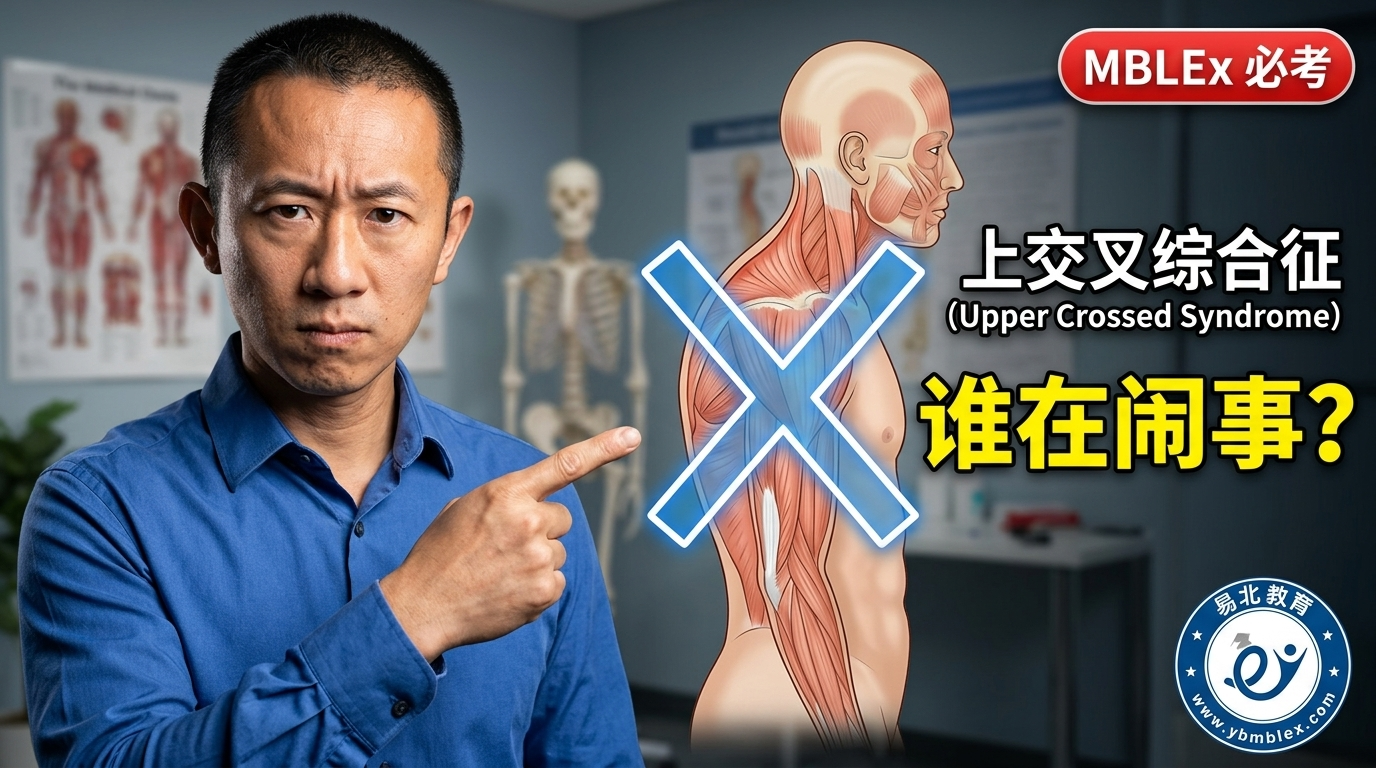
在按摩联邦考试中,**圆肩驼背**的专业术语叫做 Upper Crossed Syndrome。你可以把它想象成身体上半身的一场失控的“拔河比赛”。当我们的身体长期处于错误的姿势下,某些肌肉会因为过度工作而变得“紧(Tight)”,而另一些肌肉则会因为长期不干活而变得“弱(Weak)”。
这种肌肉之间的不平衡,最终导致了骨骼结构的偏离。考官最喜欢考的就是:在这种不平衡的状态下,哪块肌肉是那个“闹事者”(过度活跃),哪块肌肉是那个“受害者”(被拉长变弱)。如果你分不清这两者,你就会在拉伸和强化的治疗方案中选错答案,直接丢分。
考试重点:圆肩驼背不仅仅是肌肉问题,它涉及神经系统对肌肉张力的错误调节。在准备这部分内容时,掌握正确的身体力学(Body Mechanics)不仅能帮你做对题,还能保护你自己的职业寿命。
黄金公式:一紧一弱的“拔河比赛”逻辑
在**圆肩驼背**的公式里,你只需要记住四个关键词:紧(Tight/Overactive)和弱(Weak/Inhibited)。它们在身体侧面形成了一个十字交叉的结构。
1. 闹事的“紧肌肉”(需要拉伸和放松)
前面在死命拽的是:胸大肌(Pectoralis major)和胸小肌。它们像短皮筋一样把你的肩膀往怀里拉。脖子后面往上提的是:上斜方肌(Upper trapezius)和提肩胛肌。这些肌肉过度活跃,就像家里那个脾气暴躁、到处找茬的人。对待它们,按摩师的任务是“劝架”,也就是放松(Relax)和拉伸(Stretch)。
2. 受苦的“弱肌肉”(需要强化和激活)
与之相对,后背中间的菱形肌(Rhomboids)和下斜方肌(Lower trapezius)已经累得精疲力竭,它们拉不住往前冲的力量,变得无力、被拉长。它们是受害者,如果你还去拼命揉它们、拉伸它们,只会让它们更疼、更无力。对待这些肌肉,考试逻辑通常是“强化(Strengthen)”。
🎬 张老师视频讲解
文字看不够?视频里有更详细的讲解、记忆口诀和真题演练
⬆️ 点击播放,跟着张老师一起学
实战演练:如何识破考官的陷阱选项?
让我们来看一道典型的按摩联邦考试真题:
Question: In a client with Upper Crossed Syndrome, which muscle is most likely overactive and needs stretching?
A. Lower trapezius
B. Pectoralis major
C. Rhomboids
D. Serratus anterior
解题逻辑如下:题目问的是“Overactive(过度活跃)”且“needs stretching(需要拉伸)”。这意味着我们要找那个“闹事”的肌肉。根据我们的公式,后背的 Lower trapezius 和 Rhomboids 都是受害者(Weak),排除 A 和 C。前锯肌在姿势评估中有其特殊性,但在经典的**圆肩驼背**考点中,胸大肌(Pectoralis major)是绝对的首席闹事者。正确答案是 B。
如果你没掌握这个逻辑,你可能会觉得后背疼就该拉后背,那是典型的“头痛医头”,也是考官最爱挖的陷阱。分不清谁在闹事,谁在受苦,这就是很多人反复考不过的原因。这种逻辑判断能力可以通过系统训练习得,就像我们之前讨论的3个英文长句逻辑技巧一样,是通往执照的钥匙。
生活化记忆法:短皮筋与旧弹簧
为了让你在考场上秒出答案,请记住这两个生活画面:
- 🔥 紧的肌肉 = 短皮筋。太短了,死命勒着骨头,你得把它揉软。胸肌和脖子后面就是这些短皮筋。
- ⚙️ 弱的肌肉 = 旧弹簧。已经被拉长到失去弹性了,拉不住。后背中间的菱形肌就是这根废掉的弹簧。
考官问你要处理哪里?你永远去处理那个勒得太紧的短皮筋。只要画面在脑子里,哪怕你不认识那个肌肉单词的每个字母,你也能通过首字母和大概形状把答案选出来。
常见问题 FAQ
Q: 什么是圆肩驼背(Upper Crossed Syndrome)?
Q: 该考点在联邦考试中占多少比例?
Q: 为什么按摩背部不能解决圆肩驼背问题?
✅ 本文要点回顾
- 圆肩驼背的核心逻辑是肌肉的“一紧一弱”交叉失衡。
- 紧肌肉(胸大肌、上斜方肌)需要拉伸和放松。
- 弱肌肉(菱形肌、下斜方肌)需要强化和激活。
- 考试中看到后背疼,千万别急着选“拉伸背部”选项,要看前侧是否紧。
- 掌握了逻辑,英文单词再长也能通过对比和公式选出答案。
Understanding Upper Crossed Syndrome for MBLEx: A Comprehensive Guide
Upper Crossed Syndrome, often observed during a postural assessment, is a fundamental concept in massage therapy education and a frequent topic on the MBLEx. This condition, characterized by specific muscle imbalances, results in a distinct physical appearance known in Chinese as **圆肩驼背** (Round Shoulders and Kyphosis). For massage therapy students aiming for their license, understanding the underlying pathophysiology is crucial for both the examination and clinical practice.
The term “Crossed” refers to the pattern of muscle imbalance that forms a cross shape when viewed from the side. On one line of the cross, we find hyperactive or “tight” muscles. These typically include the Pectoralis Major and Pectoralis Minor on the anterior side, and the Upper Trapezius and Levator Scapulae on the posterior-superior side. These muscles are chronicaly shortened, pulling the shoulders forward and upward.
Conversely, the other line of the cross consists of “weak” or inhibited muscles. These are the Deep Cervical Flexors in the front of the neck, and the Rhomboids, Lower Trapezius, and Serratus Anterior in the back. Because these muscles are overstretched and weak, they fail to stabilize the scapula or maintain upright cervical posture. When a student encounters a question about **圆肩驼背** on the federal exam, they must identify which muscles are overactive versus which are underactive.
At YiBei Education (易北教育), we emphasize the “Tug-of-War” analogy to help students visualize this. Imagine the Pectoralis Major is a strong athlete pulling a rope, while the Rhomboids are exhausted and letting the rope slide. In a therapeutic setting, and according to MBLEx logic, the goal is to lengthen the tight muscles and strengthen the weak ones. Therefore, stretching the chest is a primary intervention for Upper Crossed Syndrome.
The clinical significance of this syndrome extends beyond mere aesthetics. Postural deviations like **圆肩驼背** can lead to tension headaches, shoulder impingement, and chronic neck pain. Massage therapists use various techniques, such as myofascial release and trigger point therapy, to address the overactive tissues. Understanding these clinical applications helps students move beyond rote memorization into critical thinking.
During the Postural Assessment section of the exam, candidates may be shown diagrams of a client’s profile. Look for the anterior head carriage and the rounding of the thoracic spine. If the question asks for the most appropriate treatment, look for options that mention relaxing the anterior chest or stretching the upper neck. If the question asks which muscle is inhibited, the answer will likely be the Rhomboids or Lower Trapezius.
Mastering these distinctions is what we call “logic-based learning.” Many Chinese-speaking students worry that their English proficiency will hinder their performance. However, by focusing on the relationship between muscles rather than just the spelling, students can decode the MBLEx. The term **圆肩驼背** serves as a mental anchor for this entire system of anatomical relationships.
In summary, postural assessment is not about memorizing a list of facts. It is about understanding how the body maintains balance and how to restore that balance when it is lost. By applying the cross-pattern logic, you can systematically eliminate incorrect answers. Remember: tight muscles pull, weak muscles let go. This simple realization is the foundation of passing the 17% weighted assessment section of your exam.
张维麟(Weilin Chang)
易北教育创始人,MBLEx 考试辅导专家。已帮助超过 634 位华人学员成功通过按摩联邦考试。专注于用中文教学帮助在美华人突破语言障碍,轻松备考,找回职业尊严。易北教育,通过考试更简易!
延伸阅读:想知道这一题在整张卷子里占什么位置,可以对照 7 大板块的官方占比——完整说明在 按摩联邦考试(MBLEx)完全指南。