很多华人考生在备考时,最怕看到像Tenosynovitis(腱鞘炎)这样又长又怪的单词。你是不是觉得这些词是专门针对咱们这些英文不好的考生的?其实,掌握医学英语词根是突破这类难题的终极密码。
什么是医学英语词根?(破解难题的偏旁部首)
医学英语词根(Medical Roots)就像中文里的偏旁部首。你看到“氵”就知道跟水有关,看到“亻”就知道跟人有关。即便你不认识这个字,你也能猜出大概的意思。在按摩联邦考试中,医学词汇同样遵循这个逻辑。
很多同学在背单词时,习惯一个字母一个字母地死记硬背。比如背“Gastr-o-enter-itis”,背了十遍还是忘。如果你掌握了规律,你会发现它是三个零件组成的:Gastr(胃)+ enter(肠)+ itis(发炎)。即便你是英文零基础,通过这把“密码钥匙”,你也能迅速反应过来这是“胃肠炎”。

这不仅仅是词汇量的问题。运用这些医学英语词根解题,能帮你节省大量的复习时间。你不需要背诵字典,只需要记住核心的50个零件,就能覆盖考试中近30%的专业词汇。如果你想了解更多关于长句逻辑的技巧,可以参考我们之前分享的零基础破解按摩联邦考试逻辑技巧。
按摩联邦考试中的黄金解题公式
在按摩联邦考试中,我们总结了一个万能公式:前缀(位置/器官)+ 后缀(症状/性质)= 答案。考官最喜欢玩的游戏,就是把一个简单的病症用学术词汇包装起来。比如“关节发炎”,他偏不写Joint Pain,他要写Arthritis。
让我们看几个常见的后缀:-itis(发炎)、-osis(退化)、-algia(疼痛)、-ectomy(切除)。只要看到-itis,不论前面是什么,你都知道它和炎症有关。如果你还没读过关于必考词汇Adhesion(粘连)的解析,建议也去看看,这些词汇经常组合出现。
考试重点:-itis 代表炎症。炎症期的按摩禁忌(Contraindications)是考试最常考的知识点,通常要求避开受损区域(Locally Contraindicated)。
实战演练:不认识单词也能做对真题
张老师在教学中经常说,看题要抓重点。如果考试问你:”A client with Tenosynovitis asks for deep tissue work on the affected hand, what should the therapist do?”
即便你不认识Ten-o-synov-itis。你看到了结尾的-itis。这说明这只手现在是红肿热痛的“发炎”状态。我问你,发炎的地方能做深层组织按摩吗?绝对不行!所以正确选项一定是关于“避开”或“轻微处理”的。这类逻辑在处理坐骨神经痛等病理考点时同样适用。
🎬 张老师视频讲解
文字看不够?视频里有更详细的讲解、记忆口诀和真题演练
⬆️ 点击播放,跟着张老师一起学
核心陷阱:-itis与-osis的致命区别
这是按摩联邦考试中最具杀伤力的陷阱。一个是-itis,一个是-osis。比如Tendinitis(腱炎)和Tendinosis(腱变性)。看似长得差不多,但作为按摩师,处理方法天差地别。
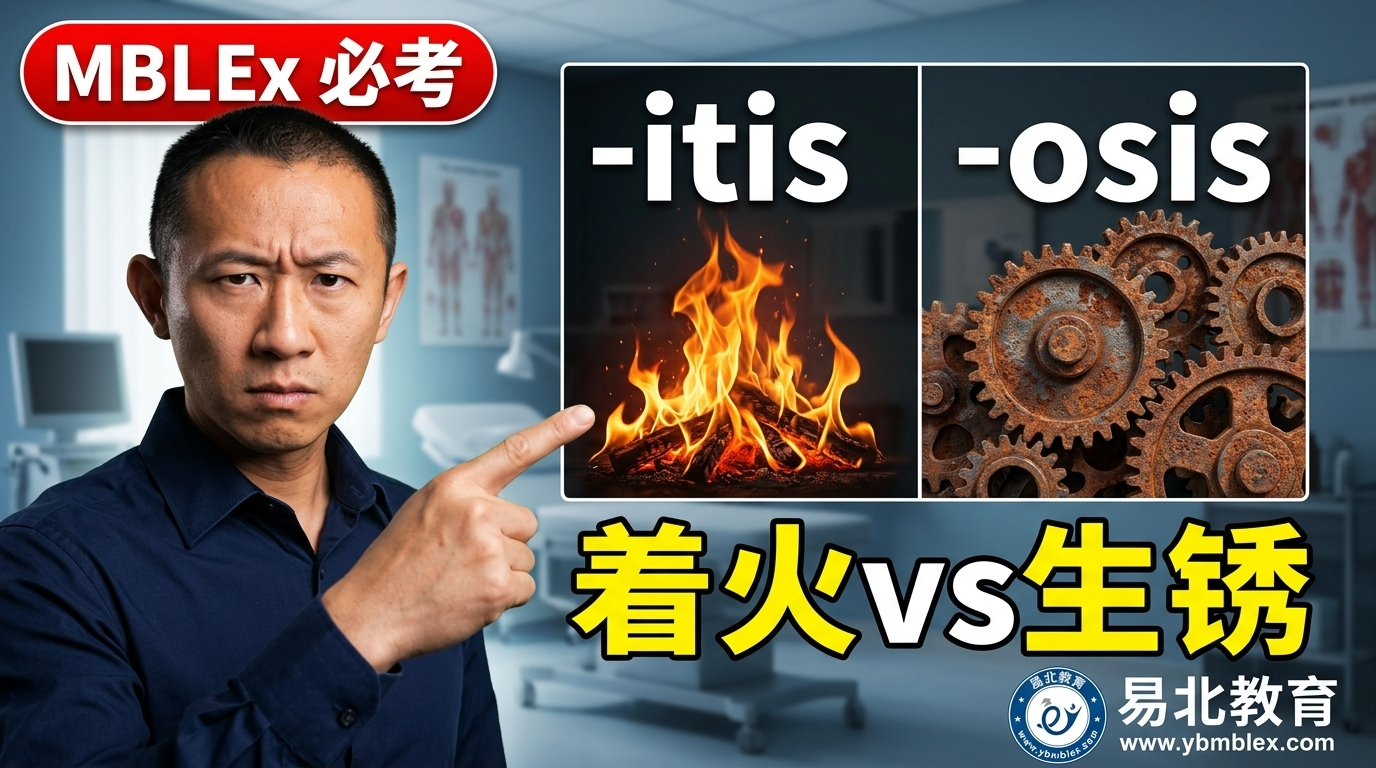
张老师给大家两个记忆锚点:🔥 -itis = 厨房着火了。着火了不能加油(按摩),要先灭火。⚙️ -osis = 门轴生锈了。生锈了需要加点油(按摩/活动),动一动就好了。考官如果把这两个词换掉,你必须能一眼识别出哪个能按,哪个不能按。
如果你能分清这个逻辑,你就不再是靠运气猜题的打工人,而是一个真正专业的持照按摩师。这不仅关乎考试分数,更关乎你在美国执业的尊严。想要更系统的备考方案吗?欢迎参加我们的试听。
常见问题 FAQ
Q: 什么是医学英语词根?
Q: 只要看到-itis就一定不能按摩吗?
Q: 医学英语词根在MBLEx考试中占比多大?
✅ 本文要点回顾
- 掌握医学英语词根是破解复杂病理单词的唯一钥匙。
- 学会公式:前缀(哪里)+ 后缀(怎么了)。
- 牢记-itis(炎症/着火)与-osis(退化/生锈)的按摩禁忌区别。
- 易北教育,通过考试更简易!

张维麟(Weilin Chang)
易北教育创始人,按摩联邦考试辅导专家。已帮助超过 600 位华人学员成功通过考试。专注于用中文教学帮助在美华人突破语言障碍,掌握医学英语词根,轻松备考。
Understanding Medical Terminology for MBLEx: A Comprehensive Guide
For many aspiring massage therapists in the United States, particularly those from non-English speaking backgrounds, the medical terminology on the MBLEx can be a major hurdle. However, understanding the structure of these words is often simpler than it appears. Most medical terms are built from ancient Greek and Latin components known in Chinese as 医学英语词根 (Medical English Word Roots). These linguistic building blocks consist of prefixes, roots, and suffixes that combine to describe specific locations, pathologies, or treatments.
At YiBei Education (易北教育), we emphasize that learning every single medical term by rote memorization is an inefficient strategy. Instead, students should focus on the underlying logic of the language. For example, the term ‘Tenosynovitis’ might look intimidating at first glance. However, when broken down, ‘Teno’ relates to a tendon, ‘synov’ relates to the synovial sheath, and ‘itis’ always signifies inflammation. By recognizing these components, a student can deduce the meaning: inflammation of the tendon sheath.
This method is particularly useful for identifying contraindications during the exam. The MBLEx frequently tests a candidate’s ability to determine whether a specific massage technique is safe for a client. If you see the suffix ‘-itis’, you know immediately that the tissue is inflamed. In clinical practice and on the exam, acute inflammation is a local contraindication. Deep tissue work or heavy friction on an area with active inflammation could worsen the condition or spread the infection.
Conversely, many students confuse ‘-itis’ with ‘-osis’. While they sound similar, they represent opposite physiological states. The suffix ‘-osis’ typically indicates a chronic condition characterized by degeneration or abnormal increase, such as Tendinosis (chronic tendon wear) or Scoliosis (abnormal spine curvature). In many cases of ‘-osis’, gentle massage and mobilization are actually beneficial to stimulate blood flow and tissue remodeling. Misidentifying these two suffixes can lead to choosing the wrong treatment protocol on the test.
Another vital root for massage therapists is ‘Myo’, which refers to muscle. When combined with ‘path’, it becomes Myopathy (muscle disease); with ‘algia’, it becomes Myalgia (muscle pain). Understanding these associations allows candidates to navigate the pathology section of the MBLEx with confidence. The musculoskeletal system alone accounts for a significant portion of the exam content. Mastering the terminology related to this system is non-negotiable for success.
Standardized tests like the MBLEx are designed by the Federation of State Massage Therapy Boards (FSMTB) to ensure entry-level competence. They use specific terminology to eliminate ambiguity. As a student at YiBei Education (易北教育), we provide you with bilingual tools to bridge the gap between your native language and the professional English required in the American healthcare industry. We focus on teaching the ‘Why’ behind the terminology, transforming students from mere test-takers into knowledgeable professionals who understand the physiological principles of their trade.
In summary, the key to conquering the medical vocabulary on the MBLEx is to treat the English language as a puzzle. By learning the most common prefixes and suffixes, you unlock the ability to interpret thousands of terms without ever opening a dictionary. This analytical approach reduces anxiety, saves time during the test, and provides a solid foundation for your future career as a licensed massage therapist. Our mission is to help you pass the exam and gain the respect and professional dignity you deserve in the United States.
备考路线图:如果你才刚开始准备,建议先从 按摩联邦考试(MBLEx)完全指南 看起,把考试范围、报名流程和备考顺序一次弄清楚,再回来啃单个考点。